

FROM THE ARCHIVE: Launching small boats....
...and letting them go

Now and then I like to post an essay I wrote long ago, in some whole other time of life. Some of these essays date back to the days when I used to publish a syndicated newspaper column called “Domestic Affairs.” This is one of those.
At the time I wrote this column, I was 32 or 33 years old, married to the father of my three children, living on our little farm at the end of a dead end road in New Hampshire. Looking back on those days now, it sometimes feels as though I was a whole other person then, living in a whole other country. Then there are times when I read one of my old stories, like this one, and I think “Yup. That was me alright. Still is.”
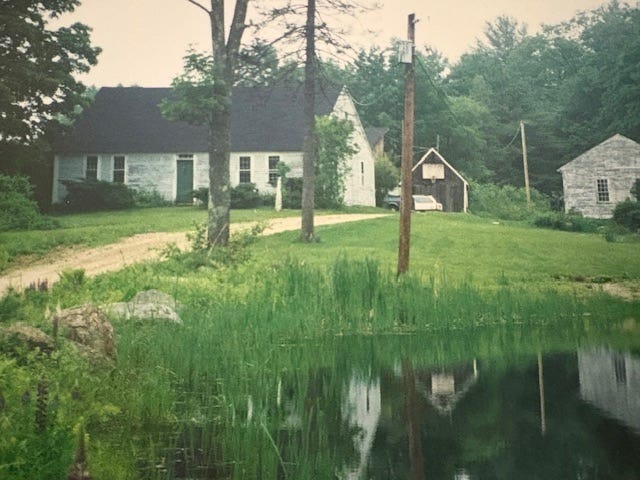
The old farmhouse in New Hampshire where I lived, in a whole other lifetime, and where my three children were born.
The essay I want to share with you today is about a tradition I used to carry out with my children when they were very small. Every year, just around the time the snow had mostly melted—meaning, right around the time we’re at now, late March—we’d spend a morning constructing little boats. Then we’d make passengers for these boats, strap them in place with rubber bands, and head down to the fast-running brook and the waterfall a half mile or so from our house, to launch our boats in the water. We’d follow along the shoreline, watching those boats make their way down the brook. Some kept bobbing along. Some got caught in the weeds. Some capsized and disappeared.
Years later—with the marriage of my youth long over, my children grown and gone, raising children of their own—I wrote a novel whose central character, a mother of three kids living with her husband on a farm in New Hampshire—does the same thing I used to do. She makes boats with her children, and tiny people to ride on them. With her children, sometime in late March, she launches those boats in a nearby brook, to meet their various fates in the rushing water.
That experience—the launching of our little homemade boats, and their passengers—struck me as a pretty apt metaphor for the experience of being a parent, as I have come to know it. You give birth to these small, infinitely precious people. You give them all the love and care you can. Then one day…or over a series of days, more likely….you launch them into the rushing water. And s much as you long to protect them, you can do little to keep them from harm. They’re on their own. You have to let them go.
As difficult as it can be, caring for a very young child, if you ask me, this is the hardest part. When all the love and care and attention you want to give them is no longer what they want from you. They’re off to live their lives.
The novel that draws from this aspect of my story ended up being called Count the Ways. It came out back in 2021. But the original title of the book, taken from the image of those little passengers we used to make, out of old wine corks, was The Cork People.
So here comes my original essay about launching those little boats of ours. This one was probably published around 1987. I would have been 33 years old. I’m 72 now.
The little boys I describe in this essay just turned 42 and 44. Their sister is 48.
I love them no less than I ever did. But they’re off living their lives now. All I can do is watch from the shore. Cheering them on when I can. (Now, for instance, when that youngest son of mine has turned up on television screens around the globe, playing a Marvel Super-Villain on a show called Daredevil. A fitting role for him, minus the part about being a bad guy. Now, as his older brother flies off to South America to perform as a DJ called Captain Planet, and his sister —living just down the road from our old farm—devotes a good part of her life to helping troubled kids, in her job as a social worker.)
As for me: I’m still writing. Books now, more than essays and columns. Still making interesting little objects at my kitchen table now and then. The photograph below shows some actual cork people I made, not so long ago, with two grown-up friends of mine, back during the pandemic, when we had time and space for doing things like that. We made 100 cork people during those early months we were sequestered, in fact. Every one different. I will add—because that number of cork people required a whole lot of corks—that we did not drink 100 bottles of wine. (Just a few of them.) The rest of the corks were donated to us by helpful, wine-loving friends.
I also want to add that in the essay I’m sharing here, I mention making boats out of pieces of styrofoam. Back in those days, I guess I didn’t think so much about environmental issues. I would never place pieces of styrofoam in a lovely New Hampshire brook any more.
Now here comes that essay .
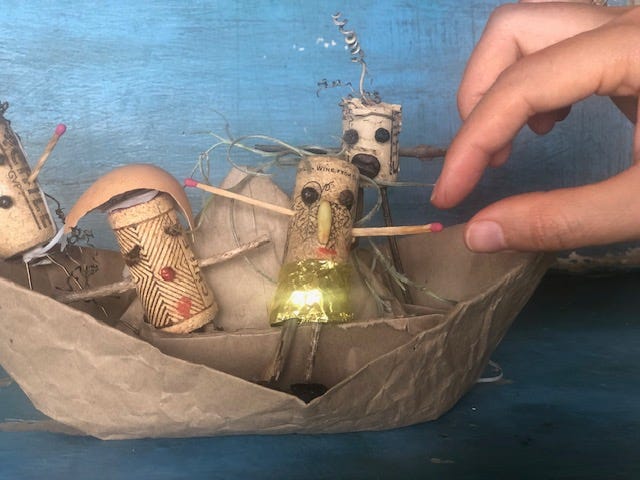
Some cork people we made. In their little boat…
A half mile down the road from our house there’s a wide rushing brook. In summer we swim there, in a place where the brook widens, and in the fall we sometimes have picnics along the banks. In winter the brook mostly freezes over, but because of the rocs and the speed of the water as it crashes over them, the ice forms thick blocks that fracture into jagged chunks and pile up, one against the other. Every winter—standing on the stone bridge over our frozen swimming hole and staring down at the way even the trees on either side have frosted over with the moisture from the brook—I think “This has to be the most beautiful time of all.”
Then comes spring: The snow melts, the ice blocks break apart and dissolve, the fiddlehead ferns stick up through the ground, watercress begins to grow in the icy water, and the brook runs so fast I can hear its roar from my back porch. And I remember that there is nothing I like better than this brook, just as it is right now.
Always, though, my love of this spot is mixed with something else, and that’s fear: Fear that when my son tosses his pebbles in to make a wish, he will lean too far over the railing and fall into those swirling waters. Fear that someday, like their father, they’ll want to jump off the high bolder at one side of the swimming hole (where, if you don’t position yourself just right, you could land on stone and break your neck.) On a walk one day with Audrey, when she was very small, we saw a gust of wind swoop down and lift her red cowboy hat right off her head and carry it down into the water, never to be seen again. And last fall, when a neighbor’s puppy disappeared, we all eventually concluded that the dog had probably gone for a dip in the book and that he’d been pulled under by the swift current.
Every spring, I make boats with my children and sail them in the brook, the same as I used to with my father, in a different brook, when I was young. With three children now, it’s not always easy to hit just the right combination of good weather, good moods, good sailing conditions, and free time. Last Saturday, everything fell into place.
It was, for starters, a beautiful day. We had a couple of friends’ children over—Ben and Aaron, around the ages of Audrey and Charlie. Everyone was getting along. Nobody was wearing the kind of shoes that couldn’t get wet. I brought out my giant box of Styrofoam blacks saved from various small-appliance purchase, odd bottle caps and old curlers, and let everyone loose with the glue. Forty five minutes later, we had five small craft—each design as distinct as its creator—and we headed for the brook.
We found a good spot for launching: a place where the water was choppy enough to make for an exciting course, but not so rough as to capsize our craft altogether. There were enough broad flat rocks that we could step across to dislodge a vessel if one got stuck on a twig or hung up on some leaves. And because the brook flowed reasonably straight there, we could follow our boats downstream a little way, instead of losing track of them in a moment when they rounded the first bend.
I want to describe these boats because each one told something about the child who made it. Charlie’s, unnamed, had a single mast, a red and black flag, the silver cap from an old shampoo bottle stuck on right in the middle. He worked very hard making this boat, and put a lot of thought into the placement of each feature. When he was all done, he announced he didn’t want to sail it. He’d rather just hold onto his boat and keep it in his room.
Aaron had chosen a more elaborate boat design, with cardboard tubes from used-up toilet paper rolls and bits of foil and a balloon and bottle caps all over the place, attached with liberal amounts of glue. Ben, his big brother, had actually gone so far as to consider flotation factors in his design. Willy cared only that he have some Styrofoam object, with a balloon attached, to fling into the water (and I was concerned chiefly with insuring that only the boat, and not Willy, got dunked. He’s that kind of person.)
Audrey had made a kind of yacht, named Amelia, with a lifeboat, a captain and a crew member made out of clothespins with glued on yarn hair, a cabin, a couple of sails, silver streamers, a purple feather sticking up from the mast, and a few forsythia blossoms at the prow. She was wiling to launch her masterpiece, but attached a long string so she’d be able to retrieve it.
I’m not sure I myself understand the curious source of the excitement produced by seeing a boat you’ve constructed actually making it from one point on a stream to another point a little farther down that stream. We all know that water flows. We all know Styrofoam floats. But launching a boat, seeing it bob along, racing along the banks to meet it, and reeling it in again farther down-well, all that is not a whole lot less thrilling to me at age thirty two than it was at age eight.
For over an hour we launched these boats and watched them go, and dislodged them from the rocks, ran ahead, met them as they came by, reeled them in, then launched them all over again. And of course Willy did get soaked. And of course the toilet paper rolls on Aaron’s boat did get waterlogged. And the sails fell off, and the balloons came undone. None of the boats looked much like boats after a while, and in truth, we didn’t look much like sailors, either.
It was getting late. Willy’s pants were so wet that I was wringing them out like a dishtowel. I told Audrey we’d take one more run, and then we’d better head for home.
But the Amelia hit a trouble spot: a little eddy of swirling water that sucked her pink balloon ballast over a rocky drop -off, causing her to capsize. Audrey managed to rescue the boat, but when she did, I heard her let out a wail. The captain and crewperson were missing, lost in the muddy depths of Beard Brook, along with the purple feather.
So I put my arms around her and we talked about bodies of water and boats. How our small brook flows into a river, and how that river flows into an even larger river, and that large river flows into the sea, which stretches all the way to England. I suppose some people might think those two clothespin people will simply end up buried in the muddy brook bed or snagged on a stick a little way downstream. As for me, I picture them washing ashore on some African beach or bobbing across the English Channel some day, round about next August, where surely there will be someone waiting to receive them, with joy and wonder.
And that, it occurs to me, is pretty much how I feel about launching children into the turbulent waters it will be up to them to navigate. Their father and I will put our mark on them for sure: we’ll lower them gently, run along the banks a ways, step out on the rocks to get them unstuck when necessary, reel them in, even, a time or two. And then they’ll be off, toward some distant and unknown destination, while we stand on the shore, waving and cheering, watching them go.
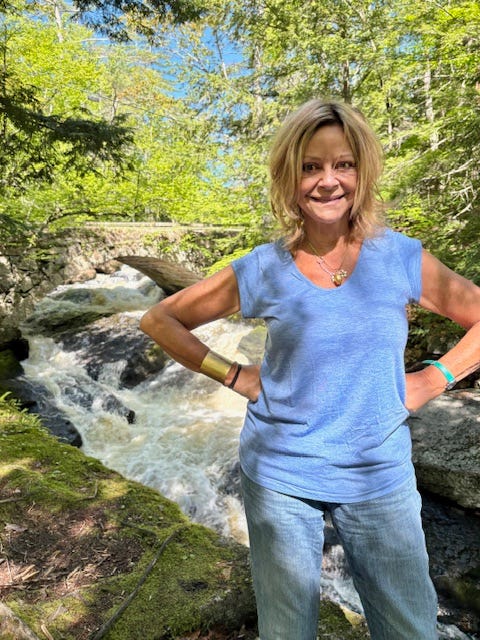
Me at our old boat-launching spot last summer in New Hampshire.
*********************************************************
Thank you, Joyce, for reminding me of your amazing book "Count The Ways". This book and its sequel have stayed with me since I read both of them. They are great books. :) <3
It’s so much fun to see the photos of the farm, the brook and the cork people after reading “Count the Ways” twice! I’m reading “How the Light Gets In” now. Your novels resonate with me. Wonderful stories and I love how you tell the story over a span of a person’s life in such a way that engages the reader.