

The Five-Minute Memoir Workshop:
Did you ever put the words "Write the story of my life" on your list of New Year's resolutions? It's day one of a whole new writing year, and I've got a little advice for you.

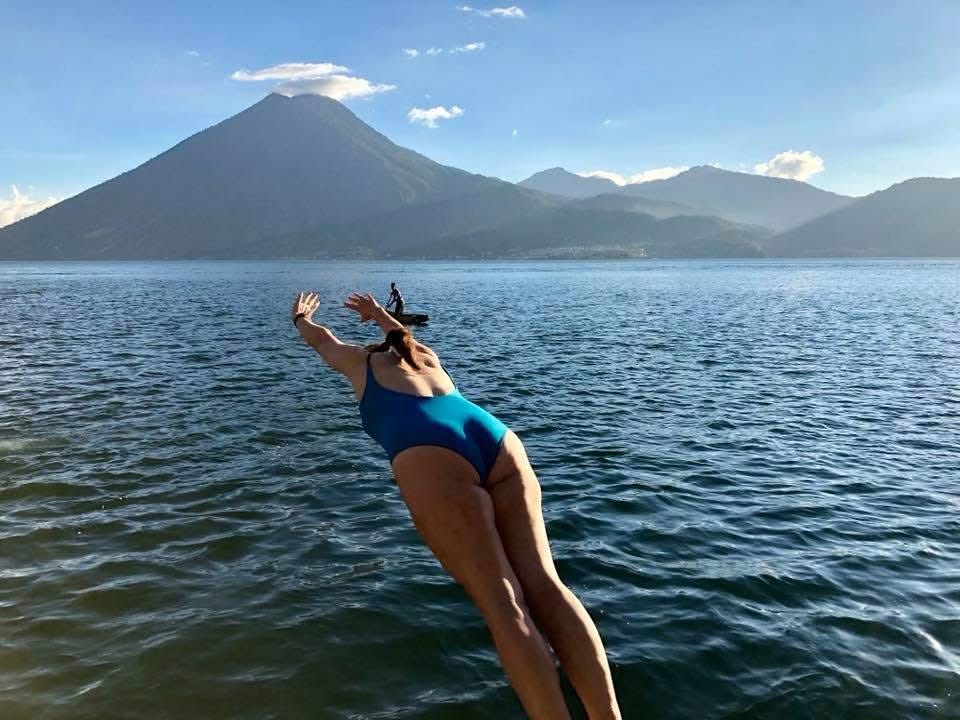
I chose this photograph of a writing student of mine at my Lake Atitlan memoir workshop a few years back because the topic for today is DIVING IN. It takes a little courage.
This one is for anybody who ever included, on her list of New Year’s resolutions, the hope of writing the story of her life.
And didn’t follow through. Or started to but got stuck. On the list of Resolutions that Don’t Get Fulfilled, writing one’s memoir may feature right below “work out every day” or “give up sugar.”
And still the dream keeps coming back, on next year’s list of resolutions. Maybe this will be the year you write that memoir? Or maybe, instead of trying once again for the same elusive goal, you might want to reconsider how you define it.
In the twenty-five years since I first led a memoir workshop—seven or eight women, gathered in my living room in Mill Valley California, drinking coffee and sharing my home made poppy seed cake and their stories-- I’ve met a lot of people who aspired to write a book about their life, and many who met with frustration when they set out to accomplish it. If you’re one such person, this is for you.
Over the course of my long career as a writer, I’ve published twelve novels, going on thirteen, but I don’t teach fiction writing. The form I believe I’m best equipped to pass on to aspiring writers is the craft of personal narrative. It’s also a form that serves as a great starting- off point for just about any other form of writing you may choose to tackle down the line—because so many of the tools I talk about when I teach memoir apply not simply to the telling of one’s own story, but to any form of storytelling you may ultimately pursue.
And though I’d never want to talk anyone out of trying to write a novel, I’ll offer this as my way of convincing you to explore personal narrative: There’s one story you know better than any other, and it’s the story nobody else can tell but you. Tell it well—with attention to language, structure, and honesty—and I believe you’ll create something meaningful and valuable, even precious. I’m not promising you’ll sign a big book contract and have a bestseller on your hands that allows you to quit your day job. But if your definition of success as a writer is creating a piece of writing that moves a reader, and makes her want to keep reading, you’ll get there.
I’ve written thousands of pages of stories about my life—three books of memoir, and hundreds of short personal essays. Some were definitely more memorable than others. But cumulatively, what they added up to has been the story (still ongoing) of a woman’s life. The process of telling that story—including the hard parts, the hardest even-- has given me a great gift: the gift of readers who told me, over the years, that they understood me, and that they felt I understood them too.
That’s an experience I hope every writer with whom I work may one day know.
I may spend long hours, day after day, alone at my desk, but I never feel alone in the world. I have treasured friends, children, grandchildren…but the most constant presence in my life over the past fifty years or so has been that of readers from all over—some who live in other countries, even. In one way or another, what these readers say is “I know you.” Also “You know me.”
It’s a very good feeling.
I understand and appreciate the yearning to publish one’s writing. Many of the writers I’ve worked with over the years have gone on to do that. But whether or not you publish your work, if you write something that allows another human being, reading it, to understand a core truth about who you are, I’ll call you a successful writer.
That’s my mission, when I teach.
So here we are on Day One of a new year, with that nagging old aspiration “write a memoir” calling out to you. Where does a person begin?
Here’s my first suggestion: Stop thinking about writing a book-length memoir and shift your goal to “telling a story”. And instead of tackling the project of telling the story of your life –a daunting prospect, for any of us—how about this? Choose one story, one moment in time, one aspect of your life, one character who moved you or changed you, inspired you, revealed something important to you, or broke your heart. One place, one year, maybe just one day. Start small.
Approach the telling of your story as you would if you were directing a movie (this is a metaphor I use a lot when I teach, by the way; Whenever I write, I see myself as a filmmaker, only the film I’m creating is one that plays inside a reader’s head). Choose a location, and a couple of actors. One of these is you. Zoom in your camera. Let me—your audience, your reader—see and hear what’s going on. Action!
Of course, the scene you choose should not be chosen arbitrarily. It should be one that haunts you. It’s probably not the happiest moment in your life. It’s a moment that contains tension, conflict, maybe longing. But it doesn’t have to be one of those big milestone moments, either. You don’t need to have climbed Mt. Everest or had a relationship with a movie star, or received a scary diagnosis, or a big award.
It could be something small and particular—the gift of a paint box when you were seven, a person you met on a train, a day you found yourself standing on the sidelines at a high school dance and a boy you liked asked you to step out on the floor with him, a frustrating job you had, that you suffered through for three years until one day you quit, a trip you made with your grandmother to the town where she was born. A meal you cooked for her. A meal she cooked for you. A time you laced up your ice skates and flew across a perfect stretch of black ice on a winter night. (I wrote that last one, actually.)
Keep it small, for starters. And specific. Ground your story in pictures, dialogue, action, tension, powerful feeling. Choose a life experience that left you changed, an experience you had that allowed you to discover something, by the time it was over, that you didn’t know before--something about a person in your life, something about yourself.
When a writer attends one of my workshops—whether for a day, or a week (and by the way, I call every single person who shows up at one of these workshops I host “a writer”), I try hard to get her away from the idea that what she’s doing is writing a book about her life. To me, that’s too tall an order, and it’s likely to lead a person to feel overwhelmed. I try to help every writer I work with zero in on one part of her story, one stretch of road she’s travelled, that took her from one place on her journey through life to a different one.
A good memoir is not “the story of my life”, but rather, the story of one piece of your life. Case in point: My memoir, At Home in the World follows the story of an outsider girl –me--with a desperate need to pleae others, who gives over her trust, and her voice, to a powerful older man when she was eighteen years old, and how she slowly reclaimed her voice, after years of keeping his secret. My memoir, The Best of Us, follows the story of meeting and falling in love with my second husband, in my late fifties, and the short span of years we had together before he died of pancreatic cancer, that revealed to me for the first time what it meant to be part of a couple.
Many aspects of my life experience don’t show up in those books. Not because they weren’t meaningful. They’re stories for another day.
I think of every memoir as a road trip. The trip might take you from one coast to the other one away, but even so, you don’t need to pass through every one of the 48 states on the Continental U.S. to get from California to Maine. There’s the northern route, and the southern route, and plenty of others in between. You choose one.
And maybe, for starters, the road trip you embark on in the piece of writing you tackle next, isn’t 3000 miles long. It might be a a trip from one town to another, or a trip down a single dirt path through the woods, or a short paddle in a kayak. The important thing is that you’re somewhere different at the end of your trip than you were when you started out. That means you’ve taken your reader to someplace new.
Now comes my advice for today, the first day of your new writing year: Slow down. Identify what road trip you’re setting out on. It won’t be the only one you’ll ever take. Just the one you’re choosing to go on today.
Approach your stories one at a time. I may learn a lot more about you from a story—well-told—about planting a tree in your back yard, or getting up in a karaoke bar for the first time and—even though you were terrified-- singing a Patsy Cline song, than I’ll get from a run-down on everything you’ve been up to from age twenty-one to today. You may learn more about me from a 1200-word essay I wrote, long ago about a night I drove back to the house I used to live in when I was married to my children’s father, to pick up my younger son, when I felt moved to fling my ex-husband’s screw gun into the snow, than you would if I regaled you with fifty pages about my first marriage and my divorce.
I’m not saying, here, that you should give up on the dream of writing a book someday. I’m suggesting that you pick one meaningful piece of your life, and look at it closely, think about why this particular story stays with you. Then try telling that story over the course of an essay of somewhere around 1700 words. The fact that you only get 1700 words to tell it will keep you on track, by the way.
And once you’ve told that story well, you get to tell another. It’s not like you’re only allowed one chance to write a piece of personal narrative. It took a long time, getting to where you are now. Why rush the process of getting it down?
Writing about my marriage, no "old man," that started in Guatemala.
Currently writing that story. Your mentoring was invaluable.