

Three-minute writing workshop:
Guess what? I'm a film-maker

This week I’m sending my thoughts from France, where I’ll be traveling for the next three weeks, speaking (in Paris, but many other cities and towns as well) about my novel, Par Ou Entre la Lumiere. If you’re an english-speaking reader of my work, you’re more likely to know that book as How the Light Gets In.
This novel came out in the U.S. last year, by the way. But it’s been getting a lot more attention in France than it did in my own country—as is often the case with my work. So I travel here every year, and ride trains all over France, speaking with readers—which has also inspired me to work hard on my French . I want to honor the readers who have given such respect and affection to my books by respecting the language of my readers here and speaking it the best I can.
I landed in Paris just five days ago, and headed straight for the train station. My first stop—and surely the most glittering of my tour, and possibly my lifetime—was the Deauville Film Festival, where my new novel was awarded the Prix Litteraire Lucien Barriere. I’d be lying if I pretended this was anything other than a big thrill.
In case you suffer from the illusion that a writer’s life is glamourous, let me say simply: Not so much. I flew to France straight from my little house in New Hampshire where, hours before heading to the airport, I was on my hands and knees in my blue jeans scrubbing the kitchen floor and noting, as I did, the presence of a visiting mouse or two.
Eighteen hours later, I was installed in a very beautiful hotel room by the ocean, where a professional makeup artist applied all sorts of interesting products and an excellent hairdresser who’d recently finished working on the hair of Pamela Anderson worked on mine. Then I slipped into a very snazzy designer dress I’d bought eight years ago—on eBay, second hand in the hopes that one day an occasion might come up to justify my putting it on. Finally, that day had arrived.
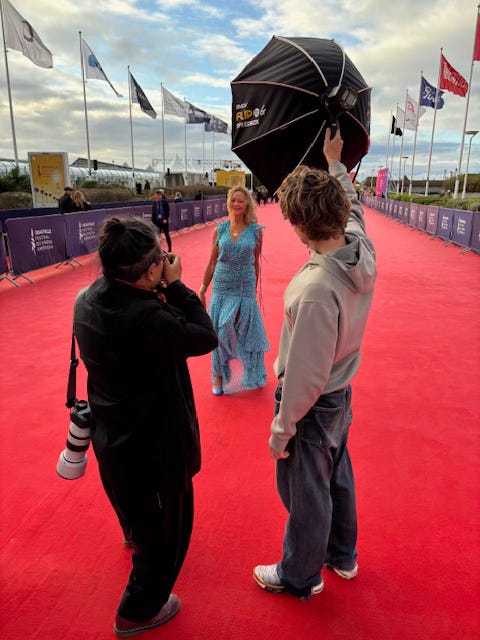
Thirty minutes later, I was walking the red carpet in my turquoise Veronica Beard dress, and into a vast theater filled with similarly well-dressed types, where they presented my award.
Forty years ago a man I used to be married to—hearing, over the phone from my hotel room, that a speech I’d just delivered in Portland Oregon had been attended by a thousand people, when I’d expected only fifty or so—reminded me “Don’t come home with a swelled head.”
And I won’t. I know what matters most in life, and what doesn’t—and at the end of the day, what matters in my writing life are two things: the writing, and the readers.
But I will admit that for that one fairy-tale night at the film festival, it was a lot of fun to step out on a stage, deliver my remarks and accept an award.
What I spoke about that night —in a speech delivered partly in French, partly in English—was the relationship between my writing process and the process of making a film. For me, at least, the two have much in common. And because I think this process of mine, when I write (fiction or memoir, either one) might be helpful to others engaged in storytelling as I have been all my life, I thought I’d share with you what I said in Deauville the other night. Perhaps it may assist you in your own writing, who knows?
Because we have come together here at a film festival, rather than the kind of place you might expect to find me—a literary festival—I want to say a few words about the role of film in my life. Particularly in the role of film in my life as a writer.
I was just nineteen years old when I published my first book. That was more than fifty years ago. When I started out, my true ambition was to make movies. Oh, I wanted to act in movies, but I also wanted to write movies. I wanted to direct! I was interested in costumes…and music…and cinematography, even lighting. Basically, I wanted to be in charge of every single thing about the movies I dreamed of making.
It took me many years to realize this, but in fact, I do make movies. The movies I make are very, very low budget films. They require no equipment other than my laptop, and when I finish making these movies, there is never a big opening at a beautiful theater like this one, with a red carpet. But never mind.
What I do, when I sit down to write, is to imagine that I am creating a movie that will play in a reader’s mind. Yours, perhaps. I set the scene, much as I would if I were sitting in a director’s chair. Then I imagine where the camera will focus—and when it will move in closer, when we will cut away to the next scene. Of course I write dialogue, but I also consider the expression on the face of each character, and how she moves—and what she wears, naturally—and how the light falls on her face. There may be music playing in this movie of mine. Or maybe the television’s on, or a baby’s crying, or you hear birds singing. Silence is also significant, however.
Twice in my career, a film has actually been adapted from a book I wrote. (One was To Die For. The other, , Labor Day.)
I like one of those movies and love the other, and I loved it that makers of film—a form I deeply revere—chose to adapt my work as they did. But here’s the truth. My best filmmaking will always take place on the page. And though, when I was young, I dreamed of making my way to Hollywood, I know now that for me the happiest and most richly rewarding place to make stories come alive is wherever I am, as long as I can find a quiet place to sit and write, and let my characters come alive and speak to you.
So very happy for you! You are amazing! Thank you for writing and taking time to instruct all of us in the art of writing even on days where you are being celebrated! You are how the light gets in. Thank you Joyce. 🎉❤️🎉 Viva la France! Enjoy your trip!
I like this so much. I've experienced that movie playing, only in my head, when I read authors like you and others I love who can bring a story to life